
This post may contain affiliate links or promotional content. We may earn a small commission at no additional cost to you. Information provided for educational purposes only. Please consult experts before making financial or legal decisions.
Consider sponsoring this post to help us share this knowledge with others! Email our team today.
Subscribe to Run The Money on Substack for more insights on financial resilience, audience growth, and building freedom in uncertain times.
Digital assets are now recognized as a legitimate financial class. Large banks, asset managers and hedge funds treat cryptocurrency as part of their strategic allocation and no longer view it as a speculative niche. That shift raises the bar for how data is collected and delivered to decision-makers across the company.
Market access alone is no longer enough. Firms need infrastructure that turns fragmented on-chain and off-chain activity into reliable inputs for investment and reporting workflows. Crypto market analysis tools sit at the center of that stack and determine who can respond fastest to changing conditions and regulatory demands.
What Crypto Market Analysis Tools Do
Crypto market analysis tools act as the data engines of a digital asset operation. They pull information from blockchains, exchanges, decentralized finance (DeFi) protocols, and even news or sentiment sources, then standardize and expose it through dashboards and application programming interfaces (APIs). Instead of teams juggling node setups, comma-separate values exports and ad hoc scripts, these platforms offer a single environment where market behavior can be inspected and tested.
This means opening access to trade data, order books and derivatives information to influence strategies and research. Risk teams rely on the same systems to track exposures across venues, monitor liquidity and meet reporting requirements. Strategy and product teams also use these platforms to see where volumes are migrating, how DeFi markets behave under pressure and which assets need to be covered more closely.
On-chain data covers everything recorded on blockchains, such as transactions, wallet balances, contract calls and event logs. Market data captures prices, volumes and order books from centralized and decentralized venues. DeFi data describes how protocols work, including liquidity pool composition, collateral ratios and yield flows. Institutions that can connect these three streams gain a clearer understanding of how capital flows and which market signals are most significant.
Key Features of a Top-Tier Analysis Platform
When institutions evaluate crypto data platforms, they tend to look for a similar core set of capabilities. The tools that make it through due diligence share common traits around coverage, depth and operational resilience.
Data Granularity and Accuracy
Many firms expect raw or near-raw data that enable them to build proprietary signals and validate vendor calculations. That may include tick-level trades, full order books and transaction-level on-chain data. Having this depth allows teams to audit their own models, respond to regulator queries and trace specific market events.
Coverage
The digital asset universe spans multiple layer-1s, layer-2s, sidechains and hundreds of DeFi protocols. Platforms that support a broad list of blockchains, decentralized applications and major centralized exchanges reduce integration work for internal teams. Wide coverage also makes it possible to track how liquidity shifts between venues, such as the flow of funds from centralized exchanges into on-chain liquidity pools.
Real-Time and Historical Access
These two need to coexist. Execution desks care about low-latency feeds and resilient streaming for intraday decision-making, while research and risk teams care just as much about long lookback periods for backtests, factor studies and stress tests. Teams need a well-documented API so data can plug into order management systems, risk engines and custom analytics without constant engineering workarounds.
Uptime and Reliability
Crypto trades around the clock, across regions and time zones. Any serious institutional setup expects data vendors to match that cadence with strong service level agreements, transparent incident reporting and a resilient underlying architecture. Companies have learned from outages in both traditional and digital markets that infrastructure risk can turn quickly into market problems.
What Are the Top-Rated Tools for Crypto Market Data Analysis?
Several platforms focus on serving institutional and professional crypto participants. Some lean into on-chain intelligence, while others specialize in exchange microstructure or research and governance coverage. Five standouts combine depth of data with products designed for real institutional workflows.
1. Amberdata

Amberdata is a premier provider of digital asset infrastructure for financial institutions. Its focus is on giving banks, asset managers and service providers a single platform that covers on-chain, DeFi and market data. That unified approach helps large organizations avoid piecing together multiple vendors and internal systems just to gain a comprehensive view of exposures.
Its main strength lies in granularity and completeness. Amberdata offers full historical datasets and real-time streaming for spot, derivatives and on-chain activity. Its APIs span wallet balances, token transfers, lending and borrowing positions, liquidity pool states and derivatives metrics. Its website also details extensive REST and WebSocket endpoints aimed at exploratory analytics and production use cases.
Companies use the platform to support research, quantitative strategy development, risk reporting and regulatory compliance. By feeding directly into internal dashboards and governance frameworks, it helps reduce operational roadblocks and ensures that different teams can work from a consistent data foundation.
2. Kaiko
Kaiko has established a strong reputation as a specialist in crypto market data, focusing on high-quality trade and order book information from centralized and decentralized exchanges. This makes it a natural fit for quantitative funds, liquidity providers and market data vendors.
The company aggregates tick-level trades, candles and depth-of-book snapshots from a wide range of venues. This allows clients to reconstruct historical order books, measure spreads and slippage, and understand how liquidity changes across markets. Kaiko’s research unit published regular analyses that draw on this data.
Institutional users rely on it for accurate pricing and backtesting inputs, while systematic traders use it to calibrate models that depend on volume, depth and microstructure signals. The appeal for professional traders comes from its focus on depth and the cleanliness of data across many exchanges.
3. Messari
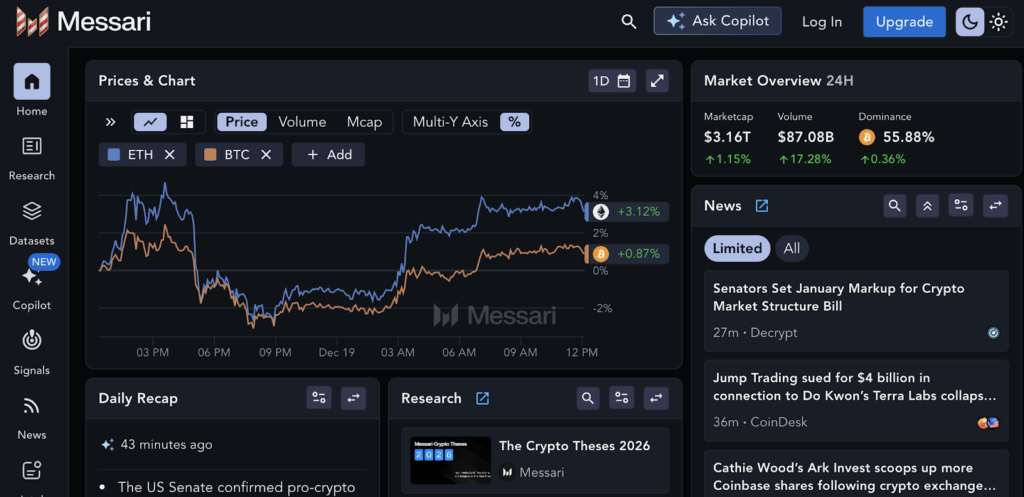
Messari serves institutions and professionals that need clear intelligence on digital assets. The platform combines asset profiles, fundamental metrics, governance tracking and industry research into one environment.
One of its best-known outputs is its annual Crypto Theses report. External summaries of the latest edition highlight how it lays out key themes across infrastructure, regulation and macro trends. It has also become a reference point for many market participants working on their yearly planning.
For asset managers and corporate strategy teams, Messari provides support for due diligence and ongoing monitoring. Users can filter assets by fundamentals, compare token economic designs, review proposals and track key events across protocols.
4. Glassnode
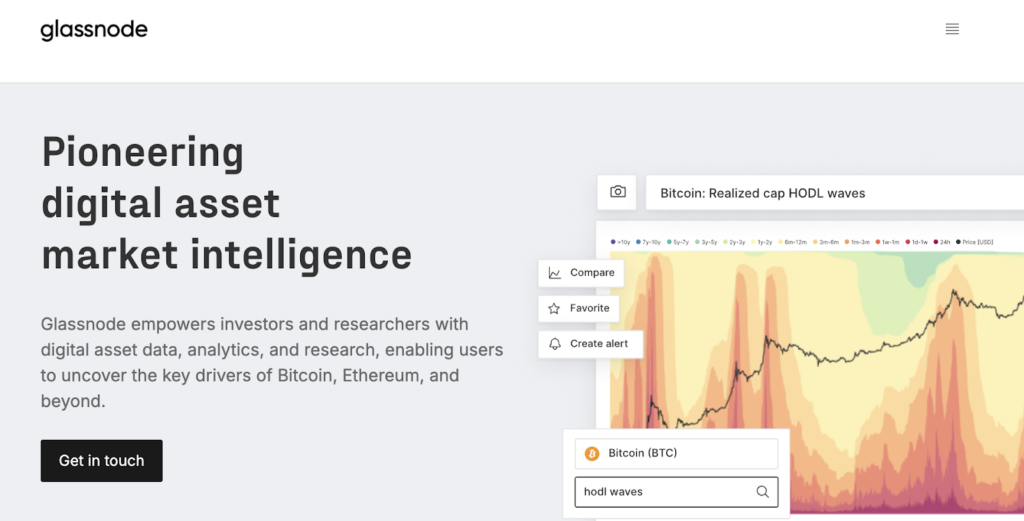
Glassnode focuses on on-chain intelligence and is one of the pioneers of metric-driven blockchain analysis. Rather than simply exposing raw records, it constructs indicators that track supply dynamics, cohort behavior and capital flows for networks such as Bitcoin and Ethereum.
It is a core tool for investors who want to understand network health, holder composition and cycle behavior using realized prices, supply age bands and more. Analysts and traders use Glassnode to complement charting and macro analysis.
Metrics on exchange inflows can give early signs of selling pressure. Long-term holder profitability and cost-basis data help identify periods where significant cohorts are in profit or underwater, which supports scenario planning and risk conversations.
5. Nansen

Nansen specializes in wallet-level analytics and entity labeling. It tracks millions of addresses across chains and flags them as funds, venture investors, exchanges, project treasuries and other categories. That makes on-chain flows more understandable, especially when capital moves quickly between ecosystems.
In 2024, it built a tool to track smart funds and their real-time trading moves, showcasing how the platform surfaces the flows and positions of successful wallets and funds for its users. Nansen’s labeling and profit and loss tracking provide a glimpse into how experienced market participants handle volatile conditions.
For traders and asset managers, Nansen helps identify early signs of interest in new tokens, non-fungible token collections or DeFi protocols. When recognized funds start entering or exiting positions, labeled data helps distinguish between noise and valuable activity. Protocol teams also use the platform to monitor token distribution, treasury actions and user segments in a more granular way.
Leading Crypto Market Analysis Tools at a Glance
The five platforms occupy different roles in an institutional setup. This table summarizes where each one shines.
| Tool | Primary Focus | Key Data Types | Best For |
| Amberdata | Institutional data infrastructure | On-chain, DeFi, market | Financial institutions |
| Kaiko | Exchange market data | Market | Quant traders and market makers |
| Messari | Research and intelligence | Fundamental, governance, market | Asset managers and researchers |
| Glassnode | On-chain intelligence | On-chain metrics | Macro and on-chain analysts |
| Nansen | Wallet and entity analytics | On-chain, labeled wallets | Traders and protocol teams |
Why Market Context Raises the Bar on Data
Policy, macro conditions and market structure shape how institutions think about risk and opportunity in the digital asset sphere. Recent developments in the United States illustrate that point. Nasdaq reported that since the start of October 2025, the total crypto market value fell from $4.2 trillion to $2.9 trillion, while highlighting progress toward a clearer regulatory stance. This includes a defined legislative framework for stablecoins and signals of a more structured, pro-crypto approach from U.S. financial regulators.
This environment combines sharp market fluctuations with evolving regulations. Institutions moving in this mix need to see exposures clearly across centralized, derivatives and on-chain activity. They also need to show boards, clients and regulators that decisions are based on transparent and auditable data. This change pushes crypto data infrastructure closer to the core of technology roadmaps for banks and financial service providers.
Making an Informed Data Decision
The top tools and platforms demonstrate how quickly the crypto data stack has matured to meet institutional needs. While each provider highlights different capabilities, the direction for the industry is clear — reliable and well-integrated data platforms are becoming essential for managing risk, uncovering opportunities and meeting rising expectations as digital assets move further into the financial mainstream.
Some content on this site is contributed by partners or external sources. All submissions are reviewed for quality.
0 responses to “From Data to Decisions with Top-Rated Crypto Market Analysis Tools”