
This post may contain affiliate links or promotional content. We may earn a small commission at no additional cost to you. Information provided for educational purposes only. Please consult experts before making financial or legal decisions.
Consider sponsoring this post to help us share this knowledge with others! Email our team today.
Subscribe to Run The Money on Substack for more insights on financial resilience, audience growth, and building freedom in uncertain times.
Ecovision started from something deeply personal—your mother’s near-fatal experience with COVID-19. When did that experience become an idea you felt you actually needed to build?
I like solving problems, and I felt helpless at that time. Doctors really didn’t have a lot of information then, and it almost felt like treatment was “just throwing spaghetti at the wall and see what sticks.” I thought back to any stressful time in her life, and she’d go for a walk. She grew up in rural Kentucky, and I knew the outdoors had always been a refuge for her, so I thought, “Why not bring nature to the bedside?” She had to be sick of staring at the same four walls, and it could be a great distraction from the pain. I also knew she was doing breathing exercises to strengthen her lungs by blowing into a device and watching a ball float. I thought I could do something more interesting in VR, like blowing bubbles or blowing petals off of a flower. I’ve always been good at tech, and I wanted to use that ability to help her.
Once you had the idea for Ecovision, what were the first concrete steps you took to turn it into something real?
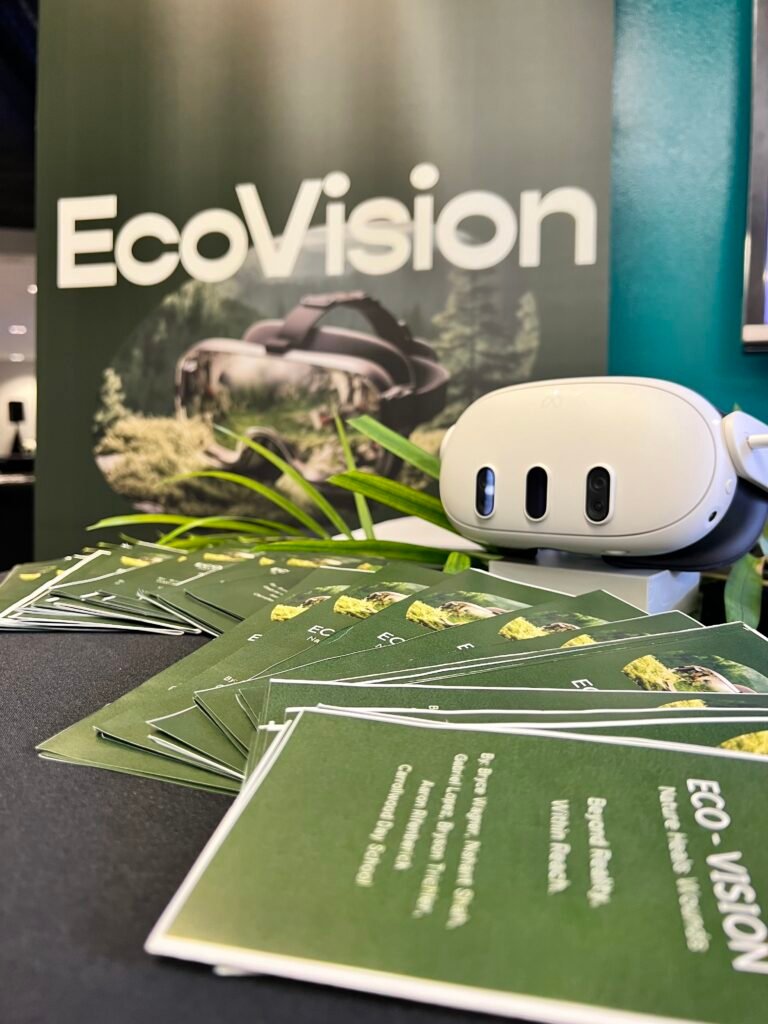
There was a lot of testing and retesting. I started with stock VR footage and then began capturing my own content. I overlaid relaxing music on some videos and incorporated guided meditation and games to keep things interesting. Eventually, I added a patent-pending scent device to enhance the immersive experience and stimulate additional parts of the brain.
You’re working at the intersection of healthcare, VR, scent technology and wellness. How do you explain Ecovision to someone hearing about it for the first time—and what problem do you believe it solves best?
“We’re bringing the healing power of nature to the bedside.”
How has being 17 shaped the way you approach conversations with researchers, organizations, investors and policymakers? Have there been any challenges—or advantages—that come with being a young entrepreneur?
Knowledge is power. It helps me build and improve the tech, solve the problem in a unique way, and gives me credibility. If you know what you are talking about, they don’t see your age. Just as in any business, it’s up to me and my partners to be able to explain our model, how it works, why we are different, and how we will scale. At the end of the day, they are investing in you. You have to exhibit the drive, an executable plan, and be a subject-matter expert in the space. AND you need an amazing team of diverse thinkers.
My partners are outstanding. We all complement each other’s skill sets.
You’ve managed to get your work in front of major organizations and decision-makers, including the WHO and United Nations. How have you created those opportunities? Was it networking, cold outreach, introductions, persistence—or some combination?
The meetings and presentations with WHO and the United Nations were part of my See Us Now Initiative to protect foster children. With Ecovision, I’ve been fortunate enough to meet with doctors and researchers from the Mayo Clinic, Moffitt Cancer Center, Slone Kettering Hospital, Atria Research Institute, and the National President of After-School All-Stars to implement Ecovision in chapters nationwide to help battle anxiety and depression in teens. The key to both passions is network, network, network. Take every meeting. You have no idea what will lead to the next advancement or connection that can be transformative for your company or cause. The other key is to know your stuff, be action-oriented, and listen even when you don’t agree. You will learn something and find commonality. In the end, people will not only like you. They will believe in you.
What has been the hardest setback, rejection or failure you’ve dealt with so far, and how did it change the way you approach your work?
I don’t like the word “failure.” Let’s just say “learning moment.” As my dad would say, “You only fail when you give up.” One learning moment for me has been sales and marketing — especially in the medical space. How do you cut through the clutter and get massive institutions to move quicker, adopt technology in real time, and trust the process? I’m a ready, fire, aim guy, so being patient and having to navigate a lot of red tape can be frustrating. On the plus side, it gives me more time to test and retest, and my product is only getting better by the second.
You’re also involved in foster-care advocacy and legislation. What has that work taught you about taking an idea from “this should change” to actually getting people with influence to pay attention?
I’ve learned an incredible amount that can be applied to business as well as advocacy. One, know the problem and its impact. Why should people care?
I quickly learned that, in order to get legislators to move, you needed their state-specific information, the costs of not helping these kids vs. helping them, and which proposed bills could move the needle. We work on both sides of the aisle, meet with all members of the committees housing our bills, and host national awareness campaigns at the same time to draw attention to the cause. We are constantly complimented on our pitch decks, meeting materials, and depth of knowledge about the issue and current proposals on the Hill. Getting the problem in front of lawmakers is key.
Remember, they can’t know everything, so don’t assume they know about your cause. Get in there and tell them about the problem, and have a solution or a bill ready to go to promote and get to work.
You’re now developing an AI tool related to food-chemical screening. How do you decide which ideas are worth pursuing when you already have several projects competing for your attention?
Food impacts everyone. When I learned that more than 10,000 unregulated chemicals had been added to the U.S. food supply due to a legislative loophole called GRAS (Generally Recognized As Safe), I was shocked. I thought there was better oversight. Also, the data showed that as these additives were introduced, obesity and health issues skyrocketed.
It’s a complicated issue, but I like to use technology to solve problems. So I started by using the Ames mutagenicity database to compare the molecular structures of known carcinogens to these food chemicals and can flag high rates of toxicity in minutes for free, instead of the current year-long review per chemical at the cost of millions of dollars. I’m now expanding into endocrine disruptors. I’m not a chemist, but I worked with chemistry professors and figured it out.
Sometimes, I believe you just have to try and not be afraid to pursue a different approach. To quote President Teddy Roosevelt, as my dad often does, “Complaining about a problem without posing a solution is called whining.”
What skills have you deliberately had to teach yourself—technical, business, communication or otherwise—that school alone probably wouldn’t have taught you?
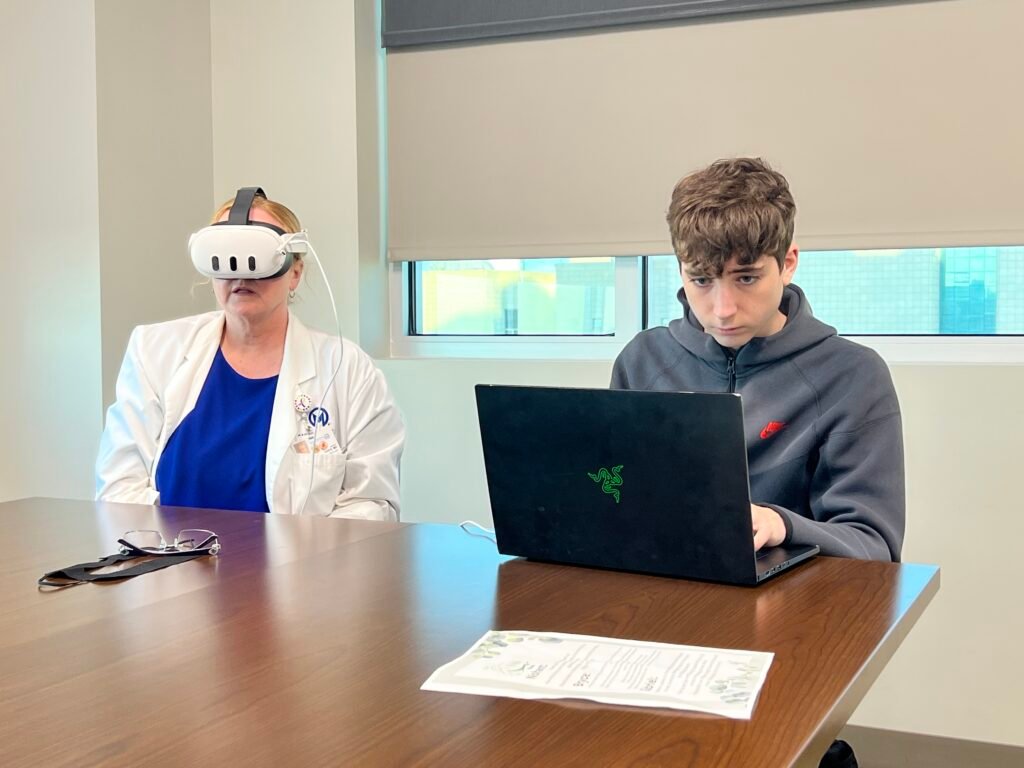
- Building things from scratch. I built my own computer because I wanted to understand how technology works, not just use it. That curiosity led me to build Charitybuzz’s iOS app, develop AI programs for USC’s Schwarzenegger Institute, and start Ecovision, a med-tech company that makes nature-based VR programs. I learned most of it by trying, breaking things, and trying again.
- Speaking the language of decision-makers. School teaches you to argue a point. Advocacy taught me to argue it in terms the other person cares about. When I met with the Speaker of the House’s legislative aide, compassion alone wasn’t going to move him. I had to show that ignoring foster kids would cost far more than helping them. Learning to turn a cause into a cost-benefit case changed everything for me.
- Listening when I disagree. It sounds simple, but it’s a skill I’ve had to practice. Some of my best insights came from people who pushed back on my ideas. Listening is also what makes negotiation possible.
- Leading without authority. As a founding member of See Us Now and president of my school’s Entrepreneurship Business Investment Team, I’ve had to recruit volunteers, speakers, and partners who didn’t have to say yes. That taught me to sell a vision, give people roles that play to their strengths, and keep a team moving.
- Pivoting. Few plans survive first contact with reality. I’ve learned to treat setbacks as information, not failure.
For another teenager—or really anyone—who has a big idea but feels too young, inexperienced or underfunded to start, what would you tell them to do in the next 30 days?
Start before you feel ready. I started advocating for foster kids when I was 10. I had no money, no title, and no experience. My great-grandfather was a deaf immigrant with little education, and he still earned a patent. What you lack matters less than you think.
Here’s how I’d spend the 30 days:
- Week 1 — Define the problem in one sentence: If you can’t explain it simply, no one will listen. Then do your research. Know the problem and the data better than anyone else. Make sure you stay current. Get the details. Know the impact. Knowledge gives you credibility and helps you create a strategy to find an obtainable solution.
- Week 2 — Build your team: Find two or three people whose strengths cover your weaknesses: a researcher, a designer, a strong speaker. At See Us Now, every pitch is a team effort, and each of us plays to our strengths. At Ecovision, our team has a diversified skill set that complements one another.
- Week 3 — Make it real: Build a simple pitch deck, prototype, or one-page plan. It doesn’t have to be perfect. It just has to be something you can put in front of people.
- Week 4 — Get in the room: Email local officials, business owners, or experts, and ask for 15 minutes. Most people are surprised how often the answer is yes, especially for a young person with a clear ask. Then listen, especially when they disagree. That’s where you’ll learn the most.
Expect to pivot, and keep going. Being young isn’t a disadvantage. It makes people pay attention.
Want more stories like this?
Read the companion edition of Run The Money on Substack and subscribe for future founder stories, experiments, and practical ideas.
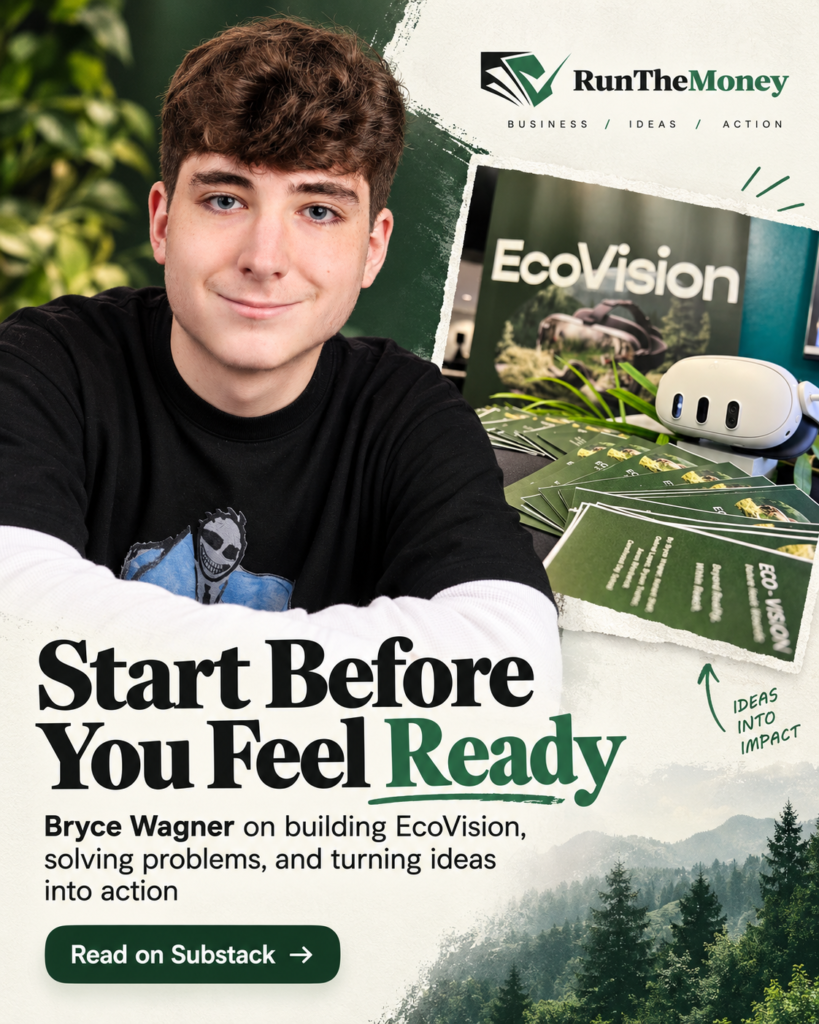
Start Before You Feel Ready
Read now: join.runthemoney.com/p/start-before-you-feel-ready
Some content on this site is contributed by partners or external sources. All submissions are reviewed for quality.
0 responses to “Start Before You Feel Ready: 17-Year-Old Founder Bryce Wagner on Turning Ideas Into Action”